Thursday, May 28, 2015

Friday, April 3, 2015
Tracking the Trajectory of a mass using linear Kalman filter
The Kalman filter is an algorithm that estimates the state of a process from measured data. The word filter comes because of the estimations given for unknown variables, are more precise than noisy, inaccurate measurements taken from the environment. Kalman filter algorithm is a two stage process. The first stage (prediction) predicts the state of the system and the second stage (observation and update) updates the predicted state using the observed noisy measurements. In this post I explain an application of tracking the trajectory of a mass using linear Kalman filter. First let's have an idea about the kinematic model of a trajectory.


Now, let's look at the discrete linear Kalman filter equations.


Matlab code
* You can download the matlab file from here.
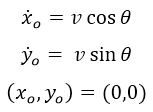 |
| Initial conditions |
Now, let's look at the discrete linear Kalman filter equations.
Matlab code
 clear all; close all; clc;
 N = 145; % no of iterations

 %% parameters
 v = 100; % initial velocity
 T = 14.42096; % flight duration
 deltaT = 0.1; % time slice
 g = 9.80665;
 theta = pi/4; % angle from the ground
 F = [1 deltaT 0 0; 0 1 0 0; 0 0 1 deltaT; 0 0 0 1]; % state transition model
 B = [0 0 0 0; 0 0 0 0; 0 0 1 0; 0 0 0 1]; % control input matrix
 u = [0; 0; 0.5*(-g)*(deltaT^2); (-g)*deltaT]; % control vector
 H = [1 0 0 0; 0 0 1 0]; % observation matrix
 phat = eye(4); % initial predicted estimate covariance
 Q = zeros(4); % process covariance
 R = 0.2*eye(2); % measurement error covariance
 xhat = [0; v*cos(theta); 200; v*sin(theta)]; % initial estimate
 x_estimate = xhat;

 %% system model
 t = 0:deltaT:T;
 x_sys = zeros(2,N);
 x_sys(1,:) = v*cos(theta)*t ;
 x_sys(2,:) = v*(sin(theta)*t)-(0.5*g*(t.^2));

 %% noisy measurements
 sigma = 25;
 z = x_sys + sigma*randn(2,N);

 %% kalman filter
 for i=1:N
   % prediction
   x_pred = F*xhat + B*u; % project the state ahead
   p_pred = F*phat*F' + Q; % project the error covariance

   % observation and update
   kalman_gain = (p_pred*H')/(H*p_pred*H'+R); % compute the Kalman gain
   xhat = x_pred + kalman_gain*(z(:,i)-H*x_pred); % update estimate with measurement z
   phat = (eye(4)-kalman_gain*H)*p_pred; % update error covariance
   x_estimate = [x_estimate xhat]; %#ok[agrow] (to ignore array grow in loop warning)
 end

 %% plot results
 figure; hold on;
 plot(x_sys(1,:),x_sys(2,:),'k');
 plot(z(1,:),z(2,:),'.b');
 plot(x_estimate(1,:),x_estimate(3,:),'--r');

 xlabel('X (meters)');
 ylabel('Y (meters)');
 title('Trajectory with linear Kalman filter');
 legend('System model', 'Measured', 'Estimated');
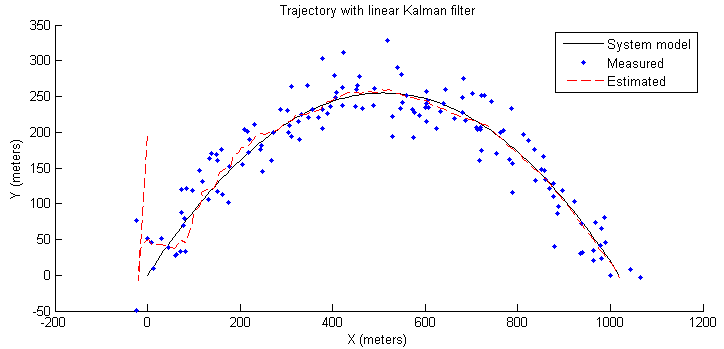.png) |
| Simulation Results |
Friday, March 27, 2015
How to add an echo effect to an audio signal using Matlab
In this post I explain how to add an echo to an audio signal using Matlab. If you closely look at the below code, you can understand, what kind of a process is there. Initially the original signal x is delayed by 0.5 seconds and then multiplied by the attenuation constant alpha(0.65) to reduce the amplitude of the echo signal. Finally the delayed and attenuated signal is added back to the original signal to get the echo effect of the audio signal. You can visualize this process using the below mentioned Matlab simulink model.
Matlab code
 clear all;
 %% Hallelujah Chorus
 [x,Fs] = audioread('Hallelujah.wav');
 sound(x,Fs);
 pause(10);
 delay = 0.5; % 0.5s delay
 alpha = 0.65; % echo strength
 D = delay*Fs;
 y = zeros(size(x));
 y(1:D) = x(1:D);

 for i=D+1:length(x)
   y(i) = x(i) + alpha*x(i-D);
 end

 %% using filter method.
 % b = [1,zeros(1,D),alpha];
 % y = filter(b,1,x);

 %% echoed Hallelujah Chorus
 sound(y,Fs);
* You can download Hallelujah.wav from here or else you can find more .wav files from WavSource.com. Varying the value of alpha would change the echo strength of the audio signal.
 |
| Original and echoed audio signals in Audacity |
You can create the Matlab simulink model for echo generation as follows.
 |
| Matlab simulink model for echo generation |
Model parameters
- From Multimedia File
samples per audio channel - 8192
Audio output sampling mode - Frame based
Audio output data type - double
- Gain
Gain - 0.65
- Delay
Delay length - 4096
Input Processing - Columns as channels (frame based)
* If you use any other .wav file other than Hallelujah.wav, then you should change the above parameters accordingly.
Friday, March 20, 2015
Frequency Divider
A frequency divider, also called a clock divider or scaler or prescaler, is a circuit that takes an input signal of a frequency, fin, and generates an output signal of a frequency :
 |
| Source - Wikipedia |
Where n is an integer (Wikipedia). In this post I explain how to implement the digital design of a simple clock divider(fin/2).
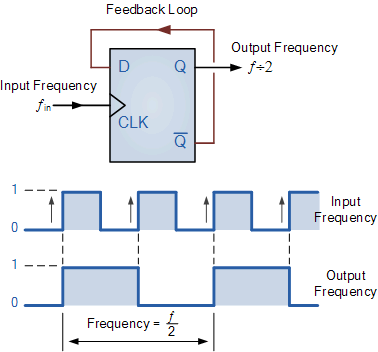 | |||
| Source - ElectronicsTutorials |
Verilog module
 module clock_divider (clk_in, enable,reset, clk_out);
   input clk_in; // input clock
   input reset;
   input enable;
   output clk_out; // output clock

   wire  clk_in;
   wire  enable;

   reg clk_out;

   always @ (posedge clk_in)
     if (reset)
       begin
         clk_out <= 1'b0;
       end
     else if (enable)
       begin
         clk_out <= !clk_out ;
       end

 endmodule
Test-bench
 module tb_clock_divider;
   reg clk_in, reset,enable;
   wire clk_out;

   clock_divider U0 (
    .clk_in (clk_in),
    .enable(enable),
    .reset (reset),
    .clk_out (clk_out)
   );

   initial
     begin
       clk_in = 0;
       reset = 0;
       enable = 1;
       #10 reset = 1;
       #10 reset = 0;
       #100 $finish;
     end

   always #5 clk_in = ~clk_in;

 endmodule
 |
| Simulation results |
 | ||||||||||||||||||
| Elaborated design |
Verilog simulation and RTL analysis was done in Vivado 2014.2. If you want to divide the input frequency further, (fin/4, fin/8, fin/16), you can extend the same circuit as follows.
 |
| Source - ElectronicsTutorials |
Tuesday, March 17, 2015
Merge Sort
The basic idea of the algorithm is to split the collection into smaller groups by halving it until the groups only have one element or no elements (which are both entirely sorted groups). Then merge the groups back together so that their elements are in order (Rosetta code). Merge sort follows divide-and-conquer approach.
Worst case performance - O(n log n)
 |
| Source - Wikipedia |
C++
 void merge_sort(int array[], int low, int high)
 {
   if (low < high)
   {
     int middle = (low + high) / 2;
     merge_sort(array,low, middle);
     merge_sort(array,middle + 1, high);
     merge(array, low, middle, high);
   }
 }

 void merge(int array[], int low, int middle, int high)
 {
   int size1 = middle - low + 1;
   int size2 = high - middle;
   int left[size1 + 1];
   int right[size2 + 1];
   for (int i = 0; i < size1; i++)
   {
     left[i] = array[low + i];
   }
   for (int j = 0; j < size2; j++)
   {
     right[j] = array[middle + j + 1];
   }
   left[size1] = numeric_limits<int>::max();;
   right[size2] = numeric_limits<int>::max();;
   int i = 0;
   int j = 0;
   for (int k = low; k <= high; k++)
   {
     if (left[i] <= right[j])
     {
       array[k] = left[i];
       i++;
     }
     else
     {
       array[k] = right[j];
       j++;
     }
   }
 }
Java
   static int[] array = {5, 4, 8, 3, 1, 2, 9, 6, 7, 10};

   static void merge_sort(int[] array, int low, int high) {
       if (low < high) {
         int middle = (low + high) / 2;
         merge_sort(array, low, middle);
         merge_sort(array, middle + 1, high);
         merge(array, low, middle, high);
       }
    }

   static void merge(int[] array, int low, int middle, int high) {
       int size1 = middle - low + 1;
       int size2 = high - middle;
       int[] left = new int[size1 + 1];
       int[] right = new int[size2 + 1];
       for (int i = 0; i < size1; i++) {
         left[i] = array[low + i];
       }
       for (int j = 0; j < size2; j++) {
         right[j] = array[middle + j + 1];
       }
       left[size1] = Integer.MAX_VALUE;
       right[size2] = Integer.MAX_VALUE;
       int i = 0;
       int j = 0;
       for (int k = low; k <= high; k++) {
         if (left[i] <= right[j]) {
           array[k] = left[i];
           i++;
         } else {
           array[k] = right[j];
           j++;
         }
       }
    }
Matlab
   function array = merge_sort(array,low,high)
     if(low < high)
       middle = floor((low + high)/2);
       array = merge_sort(array,low, middle);
       array = merge_sort(array,middle + 1, high);
       array = merge(array, low, middle, high);
     end
   end

   function array = merge(array,low,middle,high)
     size1 = middle - low + 1;
     size2 = high - middle;
     left = zeros(1,size1+1);
     right = zeros(1,size2+1);
     for i=1:size1
       left(i) = array(low+i-1);
     end
     for j=1:size2
       right(j) = array(middle+j);
     end
     left(size1+1) = inf;
     right(size2+1) = inf;
     i = 1;
     j = 1;
     for k=low:high
       if left(i)<= right(j)
         array(k) = left(i);
         i = i + 1;
       else
         array(k) = right(j);
         j = j + 1;
       end
     end
   end
Python
import math

def merge(array,low,middle,high):
    size1 = middle - low + 1
    size2 = high - middle
    left = [0]* (size1+1)
    right = [0]* (size2+1)
    for i in range(size1):
        left[i] = array[low+i]
    for j in range(size2):
        right[j] = array[middle+j+1]
    left[size1] = float("inf")
    right[size2] = float("inf")
    i = 0
    j = 0
    for k in range(low,high+1):
        if left[i]<= right[j]:
            array[k] = left[i]
            i = i + 1
        else:
            array[k] = right[j]
            j = j + 1

def merge_sort(array,low,high):
    if low<high:
        middle = int(math.floor((low+high)/2))
        merge_sort(array,low,middle)
        merge_sort(array,middle+1,high)
        merge(array,low,middle,high)
Tuesday, February 3, 2015
Bubble Sort
Bubble sort is a simple sorting algorithm that repeatedly steps through the list to be sorted, compares each pair of adjacent items and swaps them if they are in the wrong order. The pass through the list is repeated until no swaps are needed, which indicates that the list is sorted. (Wikipedia)
Worst case performance - O(n^2)
 |
| Source - Wikipedia |

C++
Javavoid bubble_sort(int array[], int length)
{
bool swapped;
do
{
swapped = false;
for (int i = 1; i < length; i++)
{
if (array[i - 1] > array[i])
{
int temp = array[i];
array[i] = array[i - 1];
array[i - 1] = temp;
swapped = true;
}
}
}
while (swapped);
}
public int[] bubble_sort(int[] array) {Matlab
boolean swapped;
do {
swapped = false;
for (int i = 1; i < array.length; i++) {
if (array[i - 1] > array[i]) {
int temp = array[i];
array[i] = array[i - 1];
array[i - 1] = temp;
swapped = true;
}
}
} while (swapped);
return array;
}
function array = bubble_sort(array)Python
length = numel(array);
swapped = true;
while swapped
swapped = false;
for i=2:length
if array(i-1)>array(i)
array([(i-1) i]) = array([i (i-1)]);
swapped = true;
end
end
end
end
def bubble_sort(array):More generally, it can happen that more than one element is placed in their final position on a single pass. In particular, after every pass, all elements after the last swap are sorted, and do not need to be checked again. (Wikipedia). Therefore we can further optimize the algorithm. Here is the Java implementation of the optimized algorithm.
swapped = True
while swapped:
swapped = False
for i in range(1,len(array)):
if array[i-1]>array[i]:
temp = array[i]
array[i] = array[i - 1]
array[i - 1] = temp
swapped = True
public int[] bubble_sort(int[] array) {
int n = array.length;
int newLimit = 0;
boolean swapped;
do {
swapped = false;
for (int i = 1; i < n; i++) {
if (array[i - 1] > array[i]) {
int temp = array[i];
array[i] = array[i - 1];
array[i - 1] = temp;
swapped = true;
newLimit = i;
}
}
n = newLimit;
} while (swapped);
return array;
}
Saturday, January 24, 2015
Selection Sort
The main idea of the algorithm is quite simple as follows. The input data array is divided to two imaginary parts, sorted and unsorted. Initially the sorted part is empty. The algorithm searches for the smallest element of the unsorted part and adds it to the end of the sorted part. When the unsorted part becomes empty algorithm stops. However Selection sort is inefficient in sorting large sets.
Worst case performance - O(n^2)
 |
| Source - Quazoo |

C++
void selection_sort(int array[], int length)
{
for (int j = 0; j < length - 1; j++)
{
int min = j;
for (int i = j + 1; i < length; i++)
{
if (array[i] < array[min])
{
min = i;
}
}
if (min != j)
{
int temp = array[j];
array[j] = array[min];
array[min] = temp;
}
}
}
Java
Matlabpublic int[] selection_sort(int[] array) {
for (int j = 0; j < array.length - 1; j++) {
int min = j;
for (int i = j + 1; i < array.length; i++) {
if (array[i] < array[min]) {
min = i;
}
}
if (min != j) {
int temp = array[j];
array[j] = array[min];
array[min] = temp;
}
}
return array;
}
function array = selection_sort(array)Python
length = numel(array);
for i = (1:length-1)
min = i;
for j = (i+1:length)
if array(j) <= array(min)
min = j;
end
end
if i ~= min
array([min i]) = array([i min]);
end
end
end
def selection_sort(array):
for j in range(len(array)-1):
min = j
for i in range(j+1,len(array)):
if array[i] < array[min]:
min = i
if min != j:
temp = array[j]
array[j] = array[min]
array[min] = temp
Subscribe to:
Posts (Atom)