Showing posts with label Algorithms. Show all posts

Sunday, August 9, 2015

Bucket Sort

Bucket sort, or bin sort, is a sorting algorithm that works by partitioning an array into a number of buckets. Each bucket is then sorted individually, either using a different sorting algorithm, or by recursively applying the bucket sorting algorithm. (Wikipedia)

Worst case performance - O(n^2)

Bucket Sort
C++
void bucket_sort(int array[], int length)
{
    int k = max_value(array,length);
    int bucket[k+1];
    for(int i=0; i<=k; i++)
    {
        bucket[i] = 0;
    }
    for(int j=0; j<length; j++)
    {
        bucket[array[j]]++;
    }
    int index = 0;
    for (int i=0; i<=k; i++)
    {
        for (int j=0; j<bucket[i]; j++)
        {
            array[index++]=i;
        }
    }
}

int max_value(int array[], int length)
{
    int max = 0;
    for (int i = 0; i < length; i++)
        if (max < array[i])
            max = array[i];
    return max;
}
Java
public int[] bucket_sort(int[] array) {
    int k = max_value(array);
    int[] bucket = new int[k+1];
    for (int j = 0; j < array.length; j++) {
        bucket[array[j]]++;
    }
    int index = 0;
    for (int i = 0; i < bucket.length; i++) {
        for (int j = 0; j < bucket[i]; j++) {
            array[index++] = i;
        }
    }
    return array;
}

public int max_value(int[] array) {
    int max = 0;
    for (int i = 0; i < array.length; i++) {
        if (max < array[i]) {
            max = array[i];
        }
    }
    return max;
}
Matlab
function array = bucket_sort(array)
    k = max(array);
    bucket = zeros(1,k+1);
    B = zeros(1,numel(array));
    for j = 1:numel(array)
        bucket(array(j)) = bucket(array(j)) + 1;
    end
    index = 1;
    for i = 1:k+1
        for j = 1:bucket(i)
            array(index) = i;
            index = index + 1;
        end
    end
end
Python
def bucket_sort(array):
    k = max(array)
    bucket = [0]* (k+1)
    for j in range(len(array)):
        bucket[array[j]] = bucket[array[j]] + 1
    index = 0
    for i in range(k+1):
        for j in range(bucket[i]):
            array[index] = i
            index = index + 1

Friday, August 7, 2015

Shell Sort

Shell sort is an in-place comparison sort. It can be seen as either a generalization of sorting by exchange (bubble sort) or sorting by insertion (insertion sort). Shell sort starts by sorting pairs of elements far apart from each other, then progressively reducing the gap between elements to be compared. (Wikipedia)

Worst case performance - O(n^2)
Shell sort

C++
void shell_sort(int array[], int length)
{
    for (int gap = length/2; gap > 0; gap /= 2)
    {
        for (int i = gap; i < length; i += 1)
        {
            int temp = array[i];
            int j;
            for (j = i; j >= gap && array[j - gap] > temp; j -= gap)
                array[j] = array[j - gap];
            array[j] = temp;
        }
    }
}
Java
     public int[] shell_sort(int[] array) {
        for (int gap = array.length / 2; gap > 0; gap /= 2) {
            for (int i = gap; i < array.length; i += 1) {
                int temp = array[i];
                int j;
                for (j = i; j >= gap && array[j - gap] > temp; j -= gap) {
                    array[j] = array[j - gap];
                }
                array[j] = temp;
            }
        }
        return array;
    } 
Matlab
function array = shell_sort(array)
    length = numel(array);
    gap = floor(length/2);
    while gap > 0
        for i = gap+1:length
            temp = array(i);
            j = i;
            while (j >= gap+1) && (array(j-gap) > temp)
                array(j) = array(j-gap);
                j = j - gap;
            end
            array(j) = temp;
        end
        gap = floor(gap/2);
    end
end
Python
import math

def shell_sort(array):
    length = len(array)
    gap = math.floor(length/2)
    while gap > 0:
        for i in range(gap,length):
            temp = array[i]
            j = i
            while (j >= gap) and (array[j - gap] > temp):
                array[j] = array[j-gap]
                j = j - gap
            array[j] = temp
        gap = math.floor(gap/2)
 

Thursday, August 6, 2015

Comb Sort

Comb sort is a comparison sorting algorithm improves on Bubble sort. The basic idea is to eliminate turtles, or small values near the end of the list, since in a bubble sort these slow the sorting down tremendously. (Wikipedia)
Comb Sort
Worst case performance - O(n^2)

C++
void comb_sort(int array[], int length)
{
    int gap = length;
    bool swapped = true;
    while((gap > 1) || (swapped == true))
    {
        gap /= 1.25;
        if (gap < 1)
        {
            gap = 1;
        }
        int i = 0;
        swapped = false;
        while (i + gap < length)
        {
            if (array[i] > array[i + gap])
            {
                int temp = array[i];
                array[i] = array[i + gap];
                array[i + gap] = temp;
                swapped = true;
            }
            i++;
        }
    }
Java
      public int[] comb_sort(int[] array) {
        int gap = array.length;
        boolean swapped = true;
        while ((gap > 1) || (swapped == true)) {
            gap /= 1.25;
            if (gap < 1) {
                gap = 1;
            }
            int i = 0;
            swapped = false;
            while (i + gap < array.length) {
                if (array[i] > array[i + gap]) {
                    int temp = array[i];
                    array[i] = array[i + gap];
                    array[i + gap] = temp;
                    swapped = true;
                }
                i++;
            }
        }
        return array;
    }
Matlab
function array = comb_sort(array)
    gap = numel(array);
    swapped = true;
    while (gap > 1) || swapped
        gap = floor(gap/1.25);
        if gap < 1
            gap = 1;
        end
        i = 1;
        swapped = false;
        while (i+gap-1) < numel(array)
            if array(i) > array(i+gap)
                array([i i+gap]) = array([i+gap i]);
                swapped = true;
            end
            i = i + 1;
        end
    end
end
Python
import math

def comb_sort(array):
    gap = len(array)
    swapped = True
    while gap > 1 or swapped :
        gap = math.floor(gap/1.25)
        if gap < 1 :
            gap = 1
        i = 0
        swapped = False
        while (i+gap)< len(array):
            if array[i] > array[i + gap]:
                temp = array[i]
                array[i] = array[i + gap]
                array[i + gap] = temp
                swapped = True
            i = i + 1

Saturday, August 1, 2015

Digital design of systolic array architecture for matrix multiplication

Systolic architecture consists of an array of processing elements, where data flows between neighboring elements, synchronously, from different directions. Processing element takes data from Top, Left and output the results to Right, Bottom.    
One of the key application of Systolic architecture is matrix multiplication. Here each processing element performs four operations, namely FETCH, MULTIPLICATION, SHIFT & ADDITION. As following figure depicts, "in_a", "in_b" are inputs to the processing element and "out_a", "out_b" are outputs to the processing element. "out_c" is to get the output result of each processing element.
Processing elements are arranged in the form of an array. In this case we analyze, multiplication of 3x3 matrices, which can be easily extended. Let say the two matrices are A and B. Following figure depicts how matrix A and B are fed into PE(processing element) array. 
Simulation of following matrices are as follows.
Verilog modules
module top(clk,reset,a1,a2,a3,b1,b2,b3,c1,c2,c3,c4,c5,c6,c7,c8,c9);

 parameter data_size=8;
 input wire clk,reset;
 input wire [data_size-1:0] a1,a2,a3,b1,b2,b3;
 output wire [2*data_size:0] c1,c2,c3,c4,c5,c6,c7,c8,c9;
 
 wire [data_size-1:0] a12,a23,a45,a56,a78,a89,b14,b25,b36,b47,b58,b69;
 
 pe pe1 (.clk(clk), .reset(reset), .in_a(a1), .in_b(b1), .out_a(a12), .out_b(b14), .out_c(c1));
 pe pe2 (.clk(clk), .reset(reset), .in_a(a12), .in_b(b2), .out_a(a23), .out_b(b25), .out_c(c2));
 pe pe3 (.clk(clk), .reset(reset), .in_a(a23), .in_b(b3), .out_a(), .out_b(b36), .out_c(c3));
 pe pe4 (.clk(clk), .reset(reset), .in_a(a2), .in_b(b14), .out_a(a45), .out_b(b47), .out_c(c4));
 pe pe5 (.clk(clk), .reset(reset), .in_a(a45), .in_b(b25), .out_a(a56), .out_b(b58), .out_c(c5));
 pe pe6 (.clk(clk), .reset(reset), .in_a(a56), .in_b(b36), .out_a(), .out_b(b69), .out_c(c6));
 pe pe7 (.clk(clk), .reset(reset), .in_a(a3), .in_b(b47), .out_a(a78), .out_b(), .out_c(c7));
 pe pe8 (.clk(clk), .reset(reset), .in_a(a78), .in_b(b58), .out_a(a89), .out_b(), .out_c(c8));
 pe pe9 (.clk(clk), .reset(reset), .in_a(a89), .in_b(b69), .out_a(), .out_b(), .out_c(c9));

endmodule

module pe(clk,reset,in_a,in_b,out_a,out_b,out_c);

 parameter data_size=8;
 input wire reset,clk;
 input wire [data_size-1:0] in_a,in_b;
 output reg [2*data_size:0] out_c;
 output reg [data_size-1:0] out_a,out_b;

 always @(posedge clk)begin
    if(reset) begin
      out_a=0;
      out_b=0;
      out_c=0;
    end
    else begin  
      out_c=out_c+in_a*in_b;
      out_a=in_a;
      out_b=in_b;
    end
 end
 
endmodule

Test-bench
module test;

 // Inputs
 reg clk;
 reg reset;
 reg [7:0] a1;
 reg [7:0] a2;
 reg [7:0] a3;
 reg [7:0] b1;
 reg [7:0] b2;
 reg [7:0] b3;

 // Outputs
 wire [16:0] c1;
 wire [16:0] c2;
 wire [16:0] c3;
 wire [16:0] c4;
 wire [16:0] c5;
 wire [16:0] c6;
 wire [16:0] c7;
 wire [16:0] c8;
 wire [16:0] c9;

 // Instantiate the Unit Under Test (UUT)
 top uut (
  .clk(clk), 
  .reset(reset), 
  .a1(a1), 
  .a2(a2), 
  .a3(a3), 
  .b1(b1), 
  .b2(b2), 
  .b3(b3), 
  .c1(c1), 
  .c2(c2), 
  .c3(c3), 
  .c4(c4), 
  .c5(c5), 
  .c6(c6), 
  .c7(c7), 
  .c8(c8), 
  .c9(c9)
 );

 initial begin
  // Initialize Inputs
  clk = 0;
  reset = 0;
  a1 = 0;
  a2 = 0;
  a3 = 0;
  b1 = 0;
  b2 = 0;
  b3 = 0;

  // Wait 100 ns for global reset to finish
  #5 reset = 1;
  #5 reset = 0;
  #5;  a1 = 1; a2 = 0; a3 = 0; b1 = 2; b2 = 0; b3 = 0;
  #10; a1 = 2; a2 = 4; a3 = 0; b1 = 4; b2 = 1; b3 = 0;
  #10; a1 = 3; a2 = 5; a3 = 7; b1 = 6; b2 = 5; b3 = 3;
  #10; a1 = 0; a2 = 6; a3 = 8; b1 = 0; b2 = 9; b3 = 7;
  #10; a1 = 0; a2 = 0; a3 = 9; b1 = 0; b2 = 0; b3 = 8;
  #10; a1 = 0; a2 = 0; a3 = 0; b1 = 0; b2 = 0; b3 = 0;
  #100;
  $stop;

 end
 
 initial begin
  forever #5 clk = ~clk;
 end
      
endmodule

Simulation results 
Output results can be seen after 6 clock periods from the time of data insertion. (time period between a1 gets 1 and the time of yellow marker). In usual case for 3x3 matrix multiplication altogether, it takes 3x3x3 = 27 times to do the iterations and calculations. But in this case it takes lesser time (x6 times), because systolic architecture is a class of parallel pipe-lined architecture. Here is the synthesis report and timing constraints of the RTL.


Target device - xc3s500e-4fg320
Tool used - Xilinx ISE 14.3
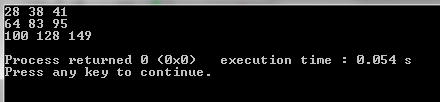
Now lets analyze the timing differences between above hardware design and the algorithm written in C++.

C++ 
#include<iostream>

using namespace std;

int main()
{
    int a[3][3] =
    {
        {1, 2, 3},
        {4, 5, 6},
        {7, 8, 9}
    };
    int b[3][3] =
    {
        {2, 1, 3},
        {4, 5, 7},
        {6, 9, 8}
    };
    int c[3][3];

    int sum;

    for(int i = 0; i < 3; i++)
    {
        for(int j = 0; j < 3; j++)
        {
            sum = 0;
            for(int k = 0; k < 3; k++)
            {
                sum += a[i][k] * b[k][j];
            }
            c[i][j] = sum;
        }
    }

    for(int i = 0; i < 3; i++)
    {
        for(int j = 0; j < 3; j++)
        {
            cout <<c[i][j]<<" ";
        }
        cout << endl;
    }
    return 0;
}
Output results

C++ execution time = 0.054s
Total delay of digital design = 7.765ns x 6 =   46.59ns 

Tuesday, July 21, 2015

Radix Sort

The idea of explained Radix Sort is to do digit by digit sort starting from least significant digit to most significant digit.

Worst case performance - O(n.k/d)

Radix sort
 C++
void radix_sort(int array[], int length)
{
    int k = max_value(array,length);
    for (int base = 1; k/base > 0; base *= 10)
        counting_sort(array,length,base);
}

void counting_sort(int array[], int length, int base)
{
    int C[10] = {0};
    int B[length];
    for (int j = 0; j < length; j++)
        C[(array[j]/base)%10]++;
    for (int i = 1; i < 10; i++)
        C[i] = C[i] + C[i - 1];
    for (int j = length - 1; j >= 0; j--)
    {
        B[C[(array[j]/base)%10] - 1] = array[j];
        C[(array[j]/base)%10]--;
    }
    for (int i = 0; i < length; i++)
        array[i] = B[i];
}

int max_value(int array[], int length)
{
    int max = 0;
    for (int i = 0; i < length; i++)
        if (max < array[i])
            max = array[i];
    return max;
Java
public int[] radix_sort(int[] array) {
    int k = max_value(array);
    for (int base = 1; k / base > 0; base *= 10) {
        array = counting_sort(array, base);
    }
    return array;
}
public int[] counting_sort(int[] array, int base) {
    int[] C = new int[10];
    int[] B = new int[array.length];
    for (int j = 0; j < array.length; j++) {
        C[(array[j]/base)%10]++;
    }
    for (int i = 1; i < 10; i++) {
        C[i] = C[i] + C[i - 1];
    }
    for (int j = array.length - 1; j >= 0; j--) {
        B[C[(array[j]/base)%10] - 1] = array[j];
        C[(array[j]/base)%10]--;
    }
    return B;
}
public int max_value(int[] array) {
    int max = 0;
    for (int i = 0; i < array.length; i++) {
        if (max < array[i]) {
            max = array[i];
        }
    }
    return max;
Matlab
function array = radix_sort(array)
k = max(array);
base = 1;
while k/base > 0
    array = counting_sort(array,base);
    base = base * 10;
end

    function B = counting_sort(array,base)
        C = zeros(1,11);
        B = zeros(1,numel(array));
        for j = 1:numel(array)
            C(rem(floor(array(j)/base),10)+1) = C(rem(floor(array(j)/base),10)+1) + 1;
        end
        for i = 2:11
            C(i) = C(i) + C(i-1);
        end
        for j = numel(array):-1:1
            B(C(rem(floor(array(j)/base),10)+1)) = array(j);
            C(rem(floor(array(j)/base),10)+1) = C(rem(floor(array(j)/base),10)+1) - 1;
        end
    end
end 
Python
import math

def counting_sort(array,base):
    C = [0]* (10)
    B = [0]* (len(array))
    for j in range(len(array)):
        C[math.floor(array[j]/base)%10] = C[math.floor(array[j]/base)%10] + 1
    for i in range(1,10):
        C[i] = C[i] + C[i-1]
    for j in range(len(array)-1,-1,-1):
        B[C[math.floor(array[j]/base)%10] - 1] = array[j]
        C[math.floor(array[j]/base)%10] = C[math.floor(array[j]/base)%10] - 1
    for i in range(len(array)):
        array[i] = B[i]

def radix_sort(array):
    k = max(array)
    base = 1
    while(k/base > 0):
        counting_sort(array,base)
        base = base * 10 

Tuesday, July 7, 2015

Counting Sort

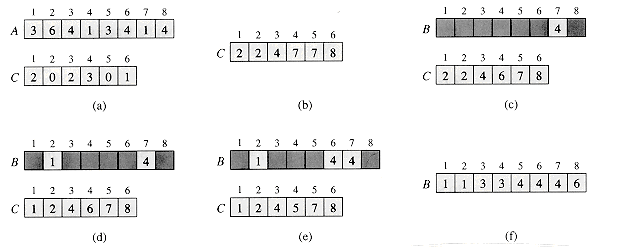
Counting sort determines, for each input element x, the number of elements less than x. It uses this information to place element x directly into its position in the output array. (Introduction to Algorithms)

Worst case performance - O(n + k)
 C++
void counting_sort(int array[], int length)
{
    int k = max_value(array,length);
    int C[k+1];
    int B[length];
    memset(C, 0, sizeof(C));
    for (int j = 0; j < length; j++)
        C[array[j]]++;
    for (int i = 1; i <= k; i++)
        C[i] = C[i] + C[i - 1];
    for (int j = length - 1; j >= 0; j--)
    {
        B[C[array[j]] - 1] = array[j];
        C[array[j]]--;
    }
    print_array(B,length);
}

int max_value(int array[], int length)
{
    int max = 0;
    for (int i = 0; i < length; i++)
        if (max < array[i])
            max = array[i];
    return max;
}

void print_array(int array[], int length)
{
    for(int i=0; i<length; i++)
        cout <<array[i]<<" ";
    cout << endl;
}
 Java
public int[] counting_sort(int[] array) {
    int k = max_value(array);
    int[] C = new int[k + 1];
    int[] B = new int[array.length];
    for (int j = 0; j < array.length; j++) {
        C[array[j]]++;
    }
    for (int i = 1; i <= k; i++) {
        C[i] = C[i] + C[i - 1];
    }
    for (int j = array.length - 1; j >= 0; j--) {
        B[C[array[j]] - 1] = array[j];
        C[array[j]]--;
    }
    return B;
}

public int max_value(int[] array) {
    int max = 0;
    for (int i = 0; i < array.length; i++) {
        if (max < array[i]) {
            max = array[i];
        }
    }
    return max;
}
 Matlab
function B = counting_sort(array)
    k = max(array);
    C = zeros(1,k+1);
    B = zeros(1,numel(array));
    for j = 1:numel(array)
        C(array(j)) = C(array(j)) + 1;
    end
    for i = 2:k+1
        C(i) = C(i) + C(i-1);
    end
    for j = numel(array):-1:1
        B(C(array(j))) = array(j);
        C(array(j)) = C(array(j)) - 1;
    end
end
 Python
def counting_sort(array):
    k = max(array)
    C = [0]* (k+1)
    B = [0]* (len(array))
    for j in range(len(array)):
        C[array[j]] = C[array[j]] + 1
    for i in range(1,k+1):
        C[i] = C[i] + C[i-1]
    for j in range(len(array)-1,-1,-1):
        B[C[array[j]] - 1] = array[j]
        C[array[j]] = C[array[j]] - 1
    print(B)

Tuesday, June 16, 2015

Heap Sort

Heap sort divides its input into a sorted and an unsorted region, and it iteratively shrinks the unsorted region by extracting the largest element and moving that to the sorted region. The improvement consists of the use of a heap data structure rather than a linear-time search to find the maximum.(Wikipedia)

Worst case performance - O(n log n)

Heap sort
C++
void heap_sort(int array[],int heap_size){
    build_max_heap(array,heap_size);
    for (int i = heap_size; i > 0; i--) {
        swap(array,0, i);
        heap_size = heap_size - 1;
        max_heapify(array, 0,heap_size);
    }
}

void build_max_heap(int array[], int heap_size){
    for (int i = heap_size / 2; i >= 0; i--){
        max_heapify(array, i,heap_size);
    }
}

void max_heapify(int array[], int i,int heap_size){
    int l = left(i);
    int r = right(i);
    int largest;
    if (l <= heap_size && array[l] > array[i]){
        largest = l;
    }
    else{
        largest = i;
    }
    if (r <= heap_size && array[r] > array[largest]){
        largest = r;
    }
    if (largest != i){
        swap(array,i, largest);
        max_heapify(array, largest,heap_size);
    }
}

int left(int i){
    return 2 * i;
}

int right(int i){
    return 2 * i + 1;
}

void swap(int array[], int i, int j)
{
    int temp = array[i];
    array[i] = array[j];
    array[j] = temp;
}

Java
    public void heap_sort(int[] array) {
        build_max_heap(array);
        for (int i = heap_size; i > 0; i--) {
            swap(0, i);
            heap_size = heap_size - 1;
            max_heapify(array, 0);
        }
    }
   
    public void build_max_heap(int[] array) {
        heap_size = array.length - 1;
        for (int i = heap_size / 2; i >= 0; i--) {
            max_heapify(array, i);
        }
    }
   
    public void max_heapify(int[] array, int i) {
        int l = left(i);
        int r = right(i);
        int largest;
        if (l <= heap_size && array[l] > array[i]) {
            largest = l;
        } else {
            largest = i;
        }
        if (r <= heap_size && array[r] > array[largest]) {
            largest = r;
        }
        if (largest != i) {
            swap(i, largest);
            max_heapify(array, largest);
        }
    }
   
    public int left(int i) {
        return 2 * i;
    }
   
    public int right(int i) {
        return 2 * i + 1;
    }
   
    public void swap(int i, int j) {
        int temp = array[i];
        array[i] = array[j];
        array[j] = temp;
    }
Matlab
function array = heap_sort(array)
    heap_size = numel(array);
    array = build_max_heap(array,heap_size);
    for i = numel(array):-1:2
        array([i 1]) = array([1 i]);
        heap_size = heap_size - 1;
        array = max_heapify(array,heap_size,1);
    end
end

function array = build_max_heap(array,heap_size)
    for i = floor(heap_size/2):-1:1
        array = max_heapify(array,heap_size,i);
    end
end

function array = max_heapify(array,heap_size,i)
    l = left(i);
    r = right(i);
    if l <= heap_size && array(l) > array(i)
        largest = l;
    else
        largest = i;
    end
    if r <= heap_size && array(r) > array(largest)
        largest = r;
    end
    if largest ~= i
        array([largest i]) = array([i largest]);
        array = max_heapify(array,heap_size,largest);
    end
end

function l = left(i)
    l = 2 * i;
end

function r = right(i)
    r = 2 * i + 1;
end
Python
import math

def left(i):
    return 2*i

def right(i):
    return 2*i+1

def max_heapify(array,heap_size,i):
    l = left(i)
    r = right(i)
    if l <= heap_size and array[l] > array[i]:
        largest = l
    else:
        largest = i
    if r <= heap_size and array[r] > array[largest]:
        largest = r
    if largest != i:
        array[largest],array[i] = array[i],array[largest]
        max_heapify(array,heap_size,largest)

def build_max_heap(array,heap_size):
    for i in range(math.floor(heap_size/2),-1,-1):
        max_heapify(array,heap_size,i)

def heap_sort(array):
    heap_size = len(array)- 1
    build_max_heap(array,heap_size)
    for i in range(heap_size,0,-1):
        array[i],array[0] = array[0],array[i]
        heap_size = heap_size - 1
        max_heapify(array,heap_size,0)

Monday, June 1, 2015

Quick Sort

Quicksort is a divide and conquer algorithm. Quicksort first divides a large array into two smaller sub-arrays, the low elements and the high elements. Quicksort can then recursively sort the sub-arrays. (Wikipedia)

Worst case performance - O(n^2)
Source - Wikipedia
 C++
void quick_sort(int array[], int low, int high)
{
    if (low < high)
    {
        int q = partition(array, low, high);
        quick_sort(array, low, q - 1);
        quick_sort(array, q + 1, high);
    }
}

int partition(int array[], int low, int high)
{
    int pivot = array[high];
    int i = low - 1;
    for (int j = low; j < high; j++)
    {
        if (array[j] <= pivot)
        {
            i++;
            swap(array, i, j);
        }
    }
    swap(array, i + 1, high);
    return i + 1;
}

void swap(int array[], int i, int j)
{
    int temp = array[i];
    array[i] = array[j];
    array[j] = temp;
}
Java
public void quick_sort(int[] array, int low, int high) {
    if (low < high) {
        int q = partition(array, low, high);
        quick_sort(array, low, q - 1);
        quick_sort(array, q + 1, high);
    }
}

public int partition(int[] array, int low, int high) {
    int pivot = array[high];
    int i = low - 1;
    for (int j = low; j < high; j++) {
        if (array[j] <= pivot) {
            i++;
            swap(array, i, j);
        }
    }
    swap(array, i + 1, high);
    return i + 1;
}

public void swap(int[] array, int i, int j) {
    int temp = array[i];
    array[i] = array[j];
    array[j] = temp;
}
Matlab
function array = quick_sort(array,low,high)
    if(low < high)
        [array,q] = partition(array, low, high);
        array = quick_sort(array, low, q - 1);
        array = quick_sort(array, q + 1, high);
    end
end

function [array,q] = partition(array,low,high)
    pivot = array(high);
    i = low - 1;
    for j= low : high - 1
        if (array(j) <= pivot)
            i = i + 1;
            array([j i]) = array([i j]);
        end
    end
    array([high i+1]) = array([i+1 high]);
    q = i + 1;
end
Python
def partition(array,low,high):
    pivot = array[high]
    i = low - 1
    for j in range(low,high):
        if array[j] <= pivot:
            i = i + 1
            array[i],array[j] = array[j],array[i]
    array[i+1],array[high] = array[high],array[i+1]
    return i+1

def quick_sort(array,low,high):
    if low < high:
        q = partition(array,low,high)
        quick_sort(array,low,q - 1)
        quick_sort(array,q + 1,high)

Friday, April 3, 2015

Tracking the Trajectory of a mass using linear Kalman filter

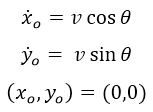
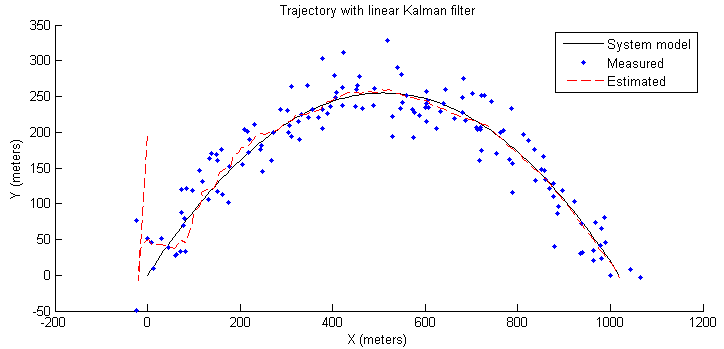
The Kalman filter is an algorithm that estimates the state of a process from measured data. The word filter comes because of the estimations given for unknown variables, are more precise than noisy, inaccurate measurements taken from the environment. Kalman filter algorithm is a two stage process. The first stage (prediction) predicts the state of the system and the second stage (observation and update) updates the predicted state using the observed noisy measurements. In this post I explain an application of tracking the trajectory of a mass using linear Kalman filter. First let's have an idea about the kinematic model of a trajectory. 

trajectory
initial conditions
Initial conditions

Kinematic equations

Now, let's look at the discrete linear Kalman filter equations.

discrete linear kalman filter equations
process model

observation model
intial prediction
assumptions

Matlab code
 clear all; close all; clc;  
 N = 145; % no of iterations  
   
 %% parameters  
 v = 100; % initial velocity  
 T = 14.42096; % flight duration  
 deltaT = 0.1; % time slice  
 g = 9.80665;   
 theta = pi/4; % angle from the ground  
 F = [1 deltaT 0 0; 0 1 0 0; 0 0 1 deltaT; 0 0 0 1]; % state transition model  
 B = [0 0 0 0; 0 0 0 0; 0 0 1 0; 0 0 0 1]; % control input matrix  
 u = [0; 0; 0.5*(-g)*(deltaT^2); (-g)*deltaT]; % control vector  
 H = [1 0 0 0; 0 0 1 0]; % observation matrix  
 phat = eye(4); % initial predicted estimate covariance  
 Q = zeros(4); % process covariance  
 R = 0.2*eye(2); % measurement error covariance  
 xhat = [0; v*cos(theta); 200; v*sin(theta)]; % initial estimate  
 x_estimate = xhat;  
   
 %% system model  
 t = 0:deltaT:T;  
 x_sys = zeros(2,N);  
 x_sys(1,:) = v*cos(theta)*t ;  
 x_sys(2,:) = v*(sin(theta)*t)-(0.5*g*(t.^2));  
   
 %% noisy measurements  
 sigma = 25;  
 z = x_sys + sigma*randn(2,N);  
   
 %% kalman filter  
 for i=1:N  
   % prediction  
   x_pred = F*xhat + B*u; % project the state ahead  
   p_pred = F*phat*F' + Q; % project the error covariance  
     
   % observation and update  
   kalman_gain = (p_pred*H')/(H*p_pred*H'+R); % compute the Kalman gain  
   xhat = x_pred + kalman_gain*(z(:,i)-H*x_pred); % update estimate with measurement z  
   phat = (eye(4)-kalman_gain*H)*p_pred; % update error covariance   
   x_estimate = [x_estimate xhat]; %#ok[agrow] (to ignore array grow in loop warning)  
 end  
   
 %% plot results  
 figure; hold on;  
 plot(x_sys(1,:),x_sys(2,:),'k');  
 plot(z(1,:),z(2,:),'.b');  
 plot(x_estimate(1,:),x_estimate(3,:),'--r');  
   
 xlabel('X (meters)');  
 ylabel('Y (meters)');  
 title('Trajectory with linear Kalman filter');  
 legend('System model', 'Measured', 'Estimated');  
simulation results
Simulation Results
 * You can download the matlab file from here.

Tuesday, March 17, 2015

Merge Sort

The basic idea of the algorithm is to split the collection into smaller groups by halving it until the groups only have one element or no elements (which are both entirely sorted groups). Then merge the groups back together so that their elements are in order (Rosetta code). Merge sort follows divide-and-conquer approach.

Worst case performance - O(n log n)

merge sort
Source - Wikipedia
 C++
 void merge_sort(int array[], int low, int high)  
 {  
   if (low < high)  
   {  
     int middle = (low + high) / 2;  
     merge_sort(array,low, middle);  
     merge_sort(array,middle + 1, high);  
     merge(array, low, middle, high);  
   }  
 }  
   
 void merge(int array[], int low, int middle, int high)  
 {  
   int size1 = middle - low + 1;  
   int size2 = high - middle;  
   int left[size1 + 1];  
   int right[size2 + 1];  
   for (int i = 0; i < size1; i++)  
   {  
     left[i] = array[low + i];  
   }  
   for (int j = 0; j < size2; j++)  
   {  
     right[j] = array[middle + j + 1];  
   }  
   left[size1] = numeric_limits<int>::max();;  
   right[size2] = numeric_limits<int>::max();;  
   int i = 0;  
   int j = 0;  
   for (int k = low; k <= high; k++)  
   {  
     if (left[i] <= right[j])  
     {  
       array[k] = left[i];  
       i++;  
     }  
     else  
     {  
       array[k] = right[j];  
       j++;  
     }  
   }  
 }   
Java
   static int[] array = {5, 4, 8, 3, 1, 2, 9, 6, 7, 10};  
   
   static void merge_sort(int[] array, int low, int high) {  
       if (low < high) {  
         int middle = (low + high) / 2;  
         merge_sort(array, low, middle);  
         merge_sort(array, middle + 1, high);  
         merge(array, low, middle, high);  
       }  
    }  
   
   static void merge(int[] array, int low, int middle, int high) {  
       int size1 = middle - low + 1;  
       int size2 = high - middle;  
       int[] left = new int[size1 + 1];  
       int[] right = new int[size2 + 1];  
       for (int i = 0; i < size1; i++) {  
         left[i] = array[low + i];  
       }  
       for (int j = 0; j < size2; j++) {  
         right[j] = array[middle + j + 1];  
       }  
       left[size1] = Integer.MAX_VALUE;  
       right[size2] = Integer.MAX_VALUE;  
       int i = 0;  
       int j = 0;  
       for (int k = low; k <= high; k++) {  
         if (left[i] <= right[j]) {  
           array[k] = left[i];  
           i++;  
         } else {  
           array[k] = right[j];  
           j++;  
         }  
       }  
    }  
Matlab
   function array = merge_sort(array,low,high)  
     if(low < high)  
       middle = floor((low + high)/2);  
       array = merge_sort(array,low, middle);  
       array = merge_sort(array,middle + 1, high);  
       array = merge(array, low, middle, high);  
     end  
   end  
   
   function array = merge(array,low,middle,high)  
     size1 = middle - low + 1;  
     size2 = high - middle;  
     left = zeros(1,size1+1);  
     right = zeros(1,size2+1);  
     for i=1:size1  
       left(i) = array(low+i-1);  
     end  
     for j=1:size2  
       right(j) = array(middle+j);  
     end  
     left(size1+1) = inf;  
     right(size2+1) = inf;  
     i = 1;  
     j = 1;  
     for k=low:high  
       if left(i)<= right(j)  
         array(k) = left(i);  
         i = i + 1;  
       else  
         array(k) = right(j);  
         j = j + 1;  
       end  
     end  
   end   
Python 
import math

def merge(array,low,middle,high):
    size1 = middle - low + 1
    size2 = high - middle
    left = [0]* (size1+1)
    right = [0]* (size2+1)
    for i in range(size1):
        left[i] = array[low+i]
    for j in range(size2):
        right[j] = array[middle+j+1]
    left[size1] = float("inf")
    right[size2] = float("inf")
    i = 0
    j = 0
    for k in range(low,high+1):
        if left[i]<= right[j]:
            array[k] = left[i]
            i = i + 1
        else:
            array[k] = right[j]
            j = j + 1
   
def merge_sort(array,low,high):
    if low<high:
        middle = int(math.floor((low+high)/2))
        merge_sort(array,low,middle)
        merge_sort(array,middle+1,high)
        merge(array,low,middle,high)

Tuesday, February 3, 2015

Bubble Sort

Bubble sort is a simple sorting algorithm that repeatedly steps through the list to be sorted, compares each pair of adjacent items and swaps them if they are in the wrong order. The pass through the list is repeated until no swaps are needed, which indicates that the list is sorted. (Wikipedia)

Worst case performance - O(n^2)

bubble sort
Source - Wikipedia
C++
void bubble_sort(int array[], int length)
{
    bool swapped;
    do
    {
        swapped = false;
        for (int i = 1; i < length; i++)
        {
            if (array[i - 1] > array[i])
            {
                int temp = array[i];
                array[i] = array[i - 1];
                array[i - 1] = temp;
                swapped = true;
            }
        }

    }
    while (swapped);
}
Java
public int[] bubble_sort(int[] array) {
    boolean swapped;
    do {
        swapped = false;
        for (int i = 1; i < array.length; i++) {
            if (array[i - 1] > array[i]) {
                int temp = array[i];
                array[i] = array[i - 1];
                array[i - 1] = temp;
                swapped = true;
            }
        }

    } while (swapped);
    return array;
}
Matlab
function array = bubble_sort(array)
    length = numel(array);
    swapped = true;
    while swapped
        swapped = false;
        for i=2:length
            if array(i-1)>array(i)
                array([(i-1) i]) = array([i (i-1)]);
                swapped = true;
            end
        end
    end
end
Python
def bubble_sort(array):
  swapped = True
 
  while swapped:
    swapped = False
   
    for i in range(1,len(array)):
      if array[i-1]>array[i]:
        temp = array[i]
        array[i] = array[i - 1]
        array[i - 1] = temp
        swapped = True
      
More generally, it can happen that more than one element is placed in their final position on a single pass. In particular, after every pass, all elements after the last swap are sorted, and do not need to be checked again. (Wikipedia). Therefore we can further optimize the algorithm. Here is the Java implementation of the optimized algorithm.

 public int[] bubble_sort(int[] array) {
    int n = array.length;
    int newLimit = 0;
    boolean swapped;
    do {
        swapped = false;
        for (int i = 1; i < n; i++) {
            if (array[i - 1] > array[i]) {
                int temp = array[i];
                array[i] = array[i - 1];
                array[i - 1] = temp;
                swapped = true;
                newLimit = i;
            }
        }
        n = newLimit;

    } while (swapped);
    return array;
}